


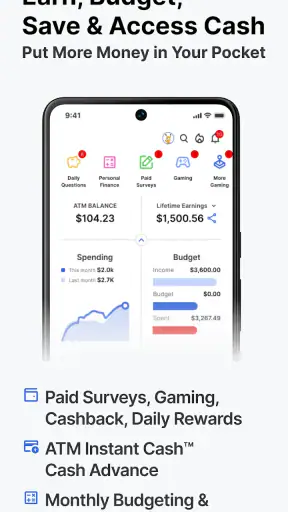
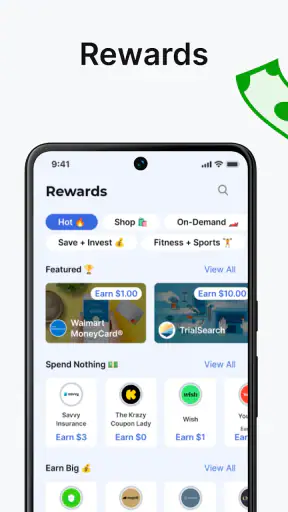
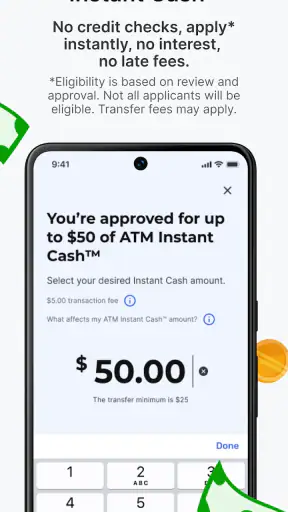
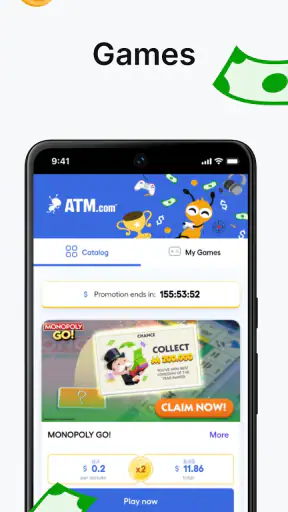
I approached ATM Cash Advance・Instant Money as a practical finance app rather than something to open casually. Its purpose is straightforward: help people look for a cash advance and manage everyday saving in one place. That combination can be useful when a bill arrives before payday, but it also demands more careful judgment than an ordinary budgeting tool. Borrowing money, even through a simple mobile interface, should be treated as a short-term decision with consequences.
My first impression is that the app is aimed at reducing the friction between recognizing a temporary cash shortage and exploring an available advance. The store summary presents instant cash advances without a credit check, while the app’s broader focus includes earning cash and saving money. I would not view that wording as a guarantee that every user receives money immediately or under identical terms. Instead, I see it as an invitation to check eligibility and review the details shown for my own situation before accepting anything.
It is a free finance app from ATM.com, Inc., available to an Everyone audience. That makes it easy to try, but free access should not be confused with free borrowing. The important cost questions are connected to the advance itself, the repayment arrangement, and the conditions displayed during the application process. I would read those screens slowly, especially when I am stressed and tempted to tap through them quickly.
How the app feels when speed matters
The strongest reason to open this app is urgency. If I discover that a utility payment, transport expense, or grocery purchase falls just before my next paycheck, a cash-advance app can feel more approachable than visiting a branch or applying for a conventional loan. The mobile format is convenient because I can begin the process from the same device I use for banking and bill reminders.
Still, “instant” should be understood as an expectation of a fast digital process, not as a promise that money will always appear at once. The actual experience can depend on the information requested, eligibility checks, account details, and the delivery method available to me. I would keep a backup plan for a genuinely time-critical payment instead of assuming that opening the app guarantees immediate funds.
There is also a useful distinction between speed of access and speed of decision-making. The app may help me reach the relevant screens quickly, but I should not let a streamlined interface rush me into borrowing. Before confirming, I would note the amount, repayment date, total obligation, and any optional or avoidable charges shown in the flow. A few extra minutes spent checking those details can matter more than saving a few taps.
For a realistic example, imagine that my car needs an unexpected repair two days before payday. I could open the app, check whether an advance is available, and compare the displayed repayment terms with alternatives such as asking the repair shop about a payment arrangement or using an existing emergency fund. If the repair is necessary and the repayment fits comfortably into my next budget, the app may be useful. If repayment would leave me short for rent or food, the fast route is probably the wrong route.
The saving and cash-earning side gives the app a little more value than a tool used only during emergencies. I can treat it as a place to look for ways to reduce the frequency of shortfalls, rather than repeatedly using advances to cover the same gap. That shift is important: a cash advance can solve timing, but it does not solve an income-and-expenses imbalance.
What happens during heavier use
Finance apps are often opened at inconvenient moments: late at night, while standing in a checkout line, or when several bills are competing for attention. In those situations, I care about clear navigation more than visual decoration. ATM Cash Advance・Instant Money works best when I use it for one defined task, such as checking an advance option or reviewing a saving opportunity, instead of trying to reorganize my entire financial life in a single session.
If I were using it repeatedly, I would avoid refreshing screens over and over while waiting for a result. Repeated attempts can make it harder to tell which step actually completed and may encourage duplicate actions. My safer workflow would be to submit information once, wait for the result, and then verify the account or transaction status before trying again. That is a small habit, but it reduces confusion when an urgent request appears to pause.
I would also avoid making a borrowing decision while multitasking. A person may open the app to check a balance, notice an advance option, and accept it without comparing the repayment date with upcoming automatic payments. My practical tip is to keep a simple note of fixed expenses for the next pay cycle before starting. That makes the app’s offer easier to judge in context and prevents the available amount from becoming the amount I feel obliged to take.
The heavier the financial pressure, the more valuable a two-step approach becomes. First, use the app to understand what is available. Second, leave the screen and compare that option with non-borrowing choices. Those alternatives might include delaying a nonessential purchase, moving money from a dedicated emergency account, or contacting a provider before a payment is missed. The app is more useful as an information point within that process than as an automatic answer to every shortage.
Resource demands are not the main reason I would choose or reject this product. It is designed for ordinary mobile use, and its finance-focused purpose does not suggest that I need a powerful device. Even so, an older phone, limited storage, a weak connection, or an outdated operating system can make any financial workflow frustrating. I would keep enough free space for normal updates and avoid starting an application while relying on an unstable public connection, particularly when entering sensitive financial information.
Reliability, interruptions, and recovering safely
Reliability in a finance app means more than whether the interface opens. I want to know what happened after an interruption, whether a request was submitted, and where I can verify the current status. If the app closes or the connection drops, I would reopen it and check the relevant history or status screen before submitting the same request again. That recovery habit is more dependable than assuming a failed-looking screen means nothing was recorded.
I would take screenshots only when they do not expose private account information, and I would never share login codes or sensitive details with someone claiming to help through an unofficial channel. A finance app can be convenient, but convenience should not weaken basic account security. If a message, notification, or screen asks me to act urgently, I would verify that it belongs to the app before proceeding.
Another practical reliability check is consistency across sessions. After setting up or reviewing an advance, I would return later and confirm the amount and repayment information rather than relying solely on memory. This is especially helpful if I use the app during a stressful event. Written confirmation inside the account gives me something concrete to compare with my budget.
The app’s public reception suggests that many people find it useful: it holds an average rating of 4.5 from roughly 54 thousand ratings, with more than 14 thousand written reviews. I treat that as encouraging but not decisive. A rating reflects a broad mix of financial situations, devices, expectations, and outcomes. My own decision would still depend on the terms presented to me and on how clearly I can understand the repayment obligation.
With more than a million installs, it is also clearly familiar to a substantial mobile audience. That scale can make an app feel less experimental, but it does not remove the need to check every transaction. A widely used service can still be unsuitable for a particular budget, and a positive rating cannot tell me whether a specific advance is affordable.
Device limits and practical setup
The listed minimum operating system is Android 8.0, so anyone using an older Android phone should check compatibility before planning around the app. For supported devices, I would install the current version shown in the store, which is 2.140.0, and keep the operating system reasonably current. Updates are especially relevant for finance software because stability and security matter more here than they do in a casual game.
I would prepare before opening the app for the first time. That means having a stable connection, knowing the bank or payment details I intend to use, and deciding how much I can repay without disrupting essential expenses. Preparing first makes the process feel slower by a minute, but it helps me distinguish a genuine emergency from an impulse to borrow simply because an option is visible.
On a shared or borrowed phone, I would be much more cautious. I would not save sensitive credentials in a place another person can access, and I would sign out when appropriate. A finance app should be used on a device with a screen lock and sensible privacy settings. These precautions are not special features of ATM Cash Advance・Instant Money; they are part of using any borrowing service responsibly.
People who need accessibility settings, a very small screen, or dependable use in poor connectivity should test the basic navigation before relying on it during an emergency. If text is difficult to read or an important confirmation is easy to miss, the app may create more risk than convenience. In that case, a phone call with a provider, a local bank, or a trusted financial counselor may be a better route.
Where it fits among the usual alternatives
Compared with a traditional bank loan, this app may feel quicker and less formal, particularly for a small, short-term need. A bank or credit union may be slower or require more documentation, but it can offer a different repayment structure and a relationship I already understand. I would compare the total cost and timing rather than choosing solely because one application has fewer screens.
Compared with a credit card, a cash advance may be more focused on a specific shortfall, while a card can remain available for repeated spending and therefore become harder to control. The better option depends on the terms, my existing balance, and whether I can repay without carrying debt forward. Neither option is automatically harmless because it is familiar or convenient.
Compared with a budgeting or savings app, ATM Cash Advance・Instant Money is more relevant when I need to examine short-term cash access alongside saving opportunities. A dedicated budgeting tool may provide deeper planning for categories, recurring expenses, and long-term goals. I would choose this app when the immediate cash-flow question is central, and a broader budgeting product when my main problem is understanding where my money goes each month.
Compared with borrowing from family or friends, the app offers a more private and structured digital route, but personal borrowing may have different financial and emotional costs. I would not assume one is universally better. The right comparison includes privacy, repayment certainty, relationship impact, and the consequences of being unable to repay on time.
Who should use it, and who should skip it
I think the app is most suitable for someone with a temporary timing problem, a predictable incoming payment, and enough room in the next budget to repay the advance. It can also suit a person who wants to explore cash-saving opportunities while keeping short-term finances in view. The key is that the advance should be a bridge, not a permanent part of the monthly plan.
I would skip it if I am already using one advance to repay another, if my essential bills are routinely larger than my income, or if I cannot state exactly how repayment will fit into the next pay cycle. In those situations, a debt counselor, bank representative, employer assistance program, or local support service may be more appropriate. The app cannot turn an ongoing deficit into a sustainable budget.
I would also avoid accepting an offer merely because the amount is available. A smaller advance may be safer than the maximum shown, and declining altogether may be wiser if the expense is optional. My most useful rule is to borrow only for a defined need, write down the repayment impact, and close the process if the numbers do not work.
There is a learning benefit in using the saving side alongside that rule. If I notice that the same emergency appears every month, I can use the app as a prompt to build a small buffer rather than normalizing repeated advances. Even modest savings can change the decision next time, although building that buffer requires consistency outside the app as well.
My performance verdict after weighing convenience against risk
ATM Cash Advance・Instant Money is appealing because it puts a potentially fast cash-access path and saving-oriented tools in a single finance app. The free download, Everyone age rating, broad Android compatibility from version 8.0 onward, and strong public adoption make it approachable for many users. I also appreciate that the concept addresses a real problem: the uncomfortable gap between when an expense arrives and when income becomes available.
My reservation is not about opening the app; it is about what happens after the first tap. The speed that makes a cash advance attractive can also reduce the time I spend comparing alternatives. I would judge the product by the clarity of the offer shown to me, the ease of checking repayment information, and how confidently I can recover after an interrupted session. Those are more important than a polished first impression.
For a one-off, manageable shortfall, I can see a practical role for it. For recurring financial stress, I would choose a broader plan and outside support instead. The app is best when it helps me make a controlled decision, not when it becomes the default response to every unexpected expense.
Overall, I would recommend trying it carefully if I need a short-term cash-flow option and can verify that repayment fits my budget. I would keep the app updated, use it on a secure device, confirm every submission after interruptions, and compare the displayed terms with a bank, card, savings, or payment-arrangement alternative. That approach preserves the convenience while respecting the most important fact about borrowing: getting money quickly is only helpful when paying it back remains comfortably realistic.


